
Opening Conditions and Scoring in 101 Okey
What the 101-point threshold means in practice, how penalties are tallied, and where the doubling rules kick in.
Opening Conditions and Scoring in 101 Okey
The 101-point opening rule is what makes 101 Okey 101 Okey. Get it wrong on round one and you'll spend the next ten rounds wondering why your score keeps climbing while everyone else's stays flat. This article unpacks how the threshold works in practice, exactly how penalties are tallied, and where the doubling rules turn a single bad round into a match-deciding swing.
What "opening" actually means
To open is to lay your formations face-up on the table for the first time during a round. You can't add tiles to anyone's melds — yours or your opponents' — until you've opened. Once you have, you can extend any meld on the table on subsequent turns.
The catch: you can only open when the total point value of your laid-down formations equals at least 101.
Counting tile values
Tile values are simple — they equal the printed number. The 7 of any colour is worth 7 points. The 13 is worth 13. The 1 is worth 1. The joker takes the value of whichever tile it's standing in for.
So a run of Red 7-8-9 is worth 24 points (7 + 8 + 9). A set of three 10s in different colours is worth 30 points (10 × 3). A four-tile set of 13s is worth 52 points (13 × 4). A run of Yellow 1-2-3 is worth a measly 6 points.
This is why high-value runs and sets matter much more than they appear to in plain Okey. A single set of three 10s gets you nearly a third of the way to 101 by itself.
Worked example: stacking up to 101
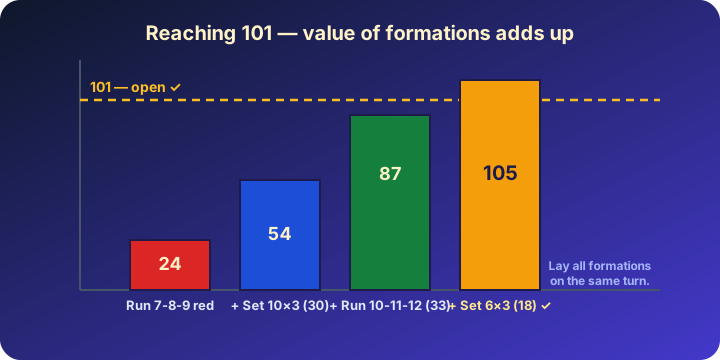
A typical opening:
| Formation | Value | Cumulative |
|---|---|---|
| Run: Red 7-8-9 | 24 | 24 |
| Set: 10/10/10 (three colours) | 30 | 54 |
| Run: 10-11-12 (same colour) | 33 | 87 |
| Set: 6/6/6 (three colours) | 18 | 105 ✓ |
You'd lay all four formations on the same turn — once you have 105 points worth of formations in hand, you commit them all at once. You cannot open with one set, then add another set the following turn to reach 101. The opening is one event.
That last set was the one that crossed the threshold. Everything you lay down on that opening turn counts toward the 101.
What happens if you miss the threshold by 5 points?
Sit on your hand and try again. You can't lay anything down until your formations cross 101. If you stayed below 101 the entire round and someone else closed it out, you receive a flat +202 penalty — the steepest round-end penalty in the game and the worst outcome short of the doubled penalties below.
How to count to 101 without counting every tile
There's a faster way than tile-by-tile arithmetic, and it's the trick experienced players use at the table: sum only the middle tile of each formation, then multiply by 3.
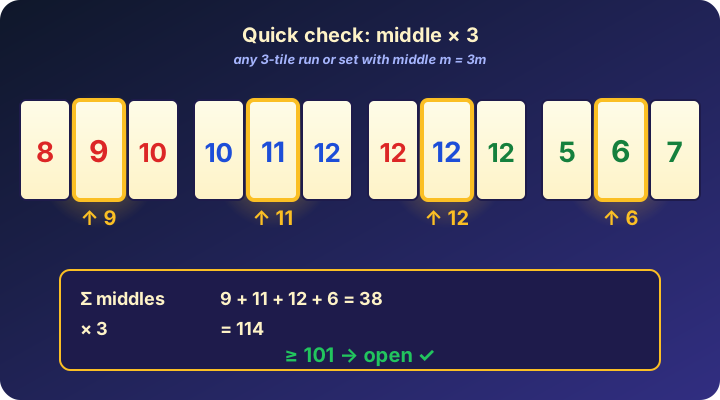
That works because any 3-tile run with middle value m sums to 3m — Red 8-9-10 = 27 = 3 × 9. Same for sets of three: three 11s in three colours = 33 = 3 × 11. So the threshold you actually need to clear is 34: 34 × 3 = 102, which is over 101.
Worked example. Four formations: middle tiles 9, 11, 12, 6. Sum = 38. ×3 = 114. You're comfortably over. No need to add 7+8+9+10+11+12+11+12+13+5+6+7 in your head.
For runs of four, take the central three (e.g. 9-10-11-12 → use 10-11-12, middle = 11) and add extra ÷ 3 to the running middle-sum. The extra tile here is 9, so 9 ÷ 3 = 3, contributing 11 + 3 = 14 to the middle-sum. ×3 = 42, which equals the actual sum 9+10+11+12 ✓. Same trick for sets of four: a fourth 11 adds 11 ÷ 3 ≈ 3.7 to the middle-sum on top of the 3-of-a-kind baseline.
In practice you'll round and use it as a gate, not an exact total — "middle-sum is 35 or higher → I can open" lets you make the call in two seconds instead of twenty.
How the round-end scoring actually works
When somebody finishes the round, three things happen for every player simultaneously:
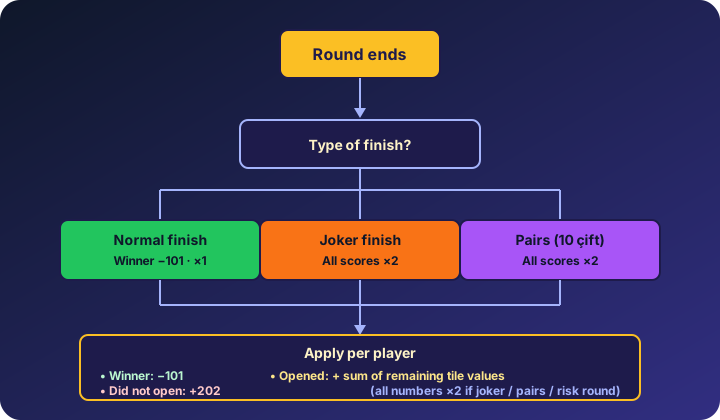
- The winner gets −101. Negative points are good — the lowest cumulative total wins the match. So scoring −101 means you're 101 points ahead.
- Players who opened but didn't win receive the sum of the numbers on their remaining tiles as penalty. If you opened with 105 worth of formations and were left holding 5 + 8 + 11 = +24 worth of unfinished tiles, you take +24.
- Players who never opened receive a flat +202 penalty regardless of what's in their hand. This is why opening matters so much: the difference between opening with a small post-opening penalty (+24) and never opening (+202) is bigger than the difference between winning (−101) and losing while opened (+24).
The doubling rules
Three situations cause all scores in the round to be multiplied by 2:
- Joker finish (çift okey). The winner discards the joker tile as their final move. Winner takes −202, openers' penalties double, non-openers go from +202 to +404.
- Pair finish (10 çift). The winner collected ten distinct pairs and announces it on their turn instead of using runs and sets. Same doubling.
- Risk round. When the indicator turned over at the start of the round is itself one of the two smiley tiles, the round is automatically a risk round. Every score at the end is doubled — and that doubling stacks on top of any joker or pair finish doubling.
A pair finish in a risk round therefore swings −404 points to the winner and +808 points to a non-opener (the +202 base, doubled by the pair finish, doubled again by the risk round). One round can move the cumulative standings more than three normal rounds combined.
Some house rules cap or skip risk rounds entirely. If you play them, agree on the multiplier upfront — disputes after the fact never end well.
Smiley tiles and the doubling rule
The two smiley tiles act as the joker for any meld purpose — they substitute for the okey inside runs and sets, and they're worth the joker's value. But they do not count as the okey for the doubling rule when discarded last. So discarding a smiley as your final tile is not a joker finish; only discarding the actual okey tile (Blue 11 in our example) counts.
If you've opened with the okey somewhere in your formations and want a joker finish, you'll need to swap the okey out of your existing meld — which is rare and tactically interesting.
Common scoring mistakes
- Forgetting the indicator was a smiley. That's a risk round and every score doubles. Easy to miss when nobody announces it explicitly.
- Assuming non-openers pay only their hand value. They pay +202 flat regardless of how few tiles they have left. The only number that matters for non-openers is +202 (or +404 if doubled).
- Forgetting the doubling stacks. Joker finish (×2) in a risk round (×2) is ×4, not ×2 + ×2. A pair-finish-in-a-risk-round is the most dramatic single round in the game.
Why the 101 threshold exists
Plain Okey ends as soon as someone completes their hand, regardless of "opening". It makes for fast, aggressive games. The 101 threshold was added to slow things down: now you have to plan a hand worth opening with, manage which tiles to discard so opponents can't steal your formations, and decide whether to take the predecessor's discard at the cost of the obligation to open immediately. It's the rule that turns Okey from a tile race into a strategy game.
Tracking it all without paper
Counting accurately across an evening of 10 or 11 rounds is the part that turns a fun game into a chore. Our free score tracker takes care of that — enter the round result on one device, share the PIN, and every player at the table sees the cumulative totals update in real time. No accounts, no installs, no arguing about who's actually winning.