
Best Opening Strategies in 101 Okey
When to open early, when to hold for tempo, and how to read your starting hand to pick the right opening line.
Best Opening Strategies in 101 Okey
The single biggest swing in 101 Okey is whether and when you open. Open too late and you eat the +202 flat penalty. Open too early on a thin hand and you'll bleed +20 to +40 in unfinished tiles. Open right and you control the tempo of the rest of the round. This guide walks through how to read your starting hand, which opening lines are worth pursuing, and the few situations where folding into pure defence is the better call.
First things first: read what you were dealt
Before you reach for a single tile from the pile, lay your 21 starting tiles in front of you and scan for shape. You're looking for four things:
- Same-colour clusters of 3+ tiles within four numbers of each other. These become runs.
- Pairs of the same number in different colours. These can grow into sets.
- The joker. Worth ~10–13 flexible points; check whether it sits naturally inside an emerging meld.
- High-value tiles (10–13). A set or run of high tiles gets you a third of the way to 101 by itself.
If you have two clusters that look like runs and one cluster that looks like a set, you have a textbook opening hand and should commit to it.

The three openable archetypes
1. The textbook: two runs + one set in three different colours
Two runs of 3 tiles each plus a set of 3 in three different colours. Average hand value: 80–110 points before adding any high tiles. Easy to open, easy to extend afterwards. If you have this, your only decision is which tiles to draw next to round up the missing one or two for 101.
Example: Red 7-8-9 (24) + Blue 5-6-7 (18) + 12/12/12 in three colours (36) = 78. Add a single Red 10 to extend the first run, or a fourth 12 to grow the set, and you're at 88–90. Two more decent draws and you open.
2. High density: 4-tile run + 4-tile set
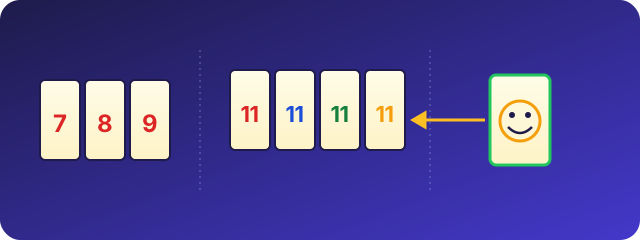
Four-tile run plus a four-tile set means you're laying eight tiles instead of nine but at higher per-tile value. Harder to complete because you need both formations to length, but if you do, you open with very little left in your hand — meaning a smaller post-opening penalty if someone else closes before you finish.
Example: Red 9-10-11-12 (42) + 11/11/11/11 (44) = 86. One more high tile (a pair to a 13, say) gets you over.
3. Joker-friendly: three loose sets, one tile missing each
Three sets of 3 where each is missing one tile. The joker can finish any one of them, then you only need the joker plus two more tiles from the pile/discards to round out 101. This is the most flexible archetype but also the slowest — you're betting that the live tiles you need will be drawable.
Example: 8/8/_ + 11/11/_ + 5/5/_, joker in hand. Use the joker on the 11s to make 33, plus another set worth 24, plus another worth 15… you're at 72 with three formations and a joker placed; you need 29 more from one or two extensions.
When to open the moment you can
A faster mental math first. Instead of summing every tile to check 101, sum only the middle tile of each formation and multiply by 3 — a 3-tile run with middle m always sums to 3m. The threshold to clear is a middle-sum of 34 (34 × 3 = 102). Walk-through with a 4-tile run worked example in the opening-and-scoring-rules guide.
The moment you cross 101, open. Every additional turn you wait risks somebody else closing the round and dumping you on the +202 flat penalty.
There's a common beginner mistake: "I have 105 but maybe I'll wait one more turn to push to 130 and play safer." Don't. Once you've opened, you can keep extending your melds to bleed out your remaining tiles. Waiting buys you nothing while your opponents tighten.
When to delay opening
The exception: when opening would leave you holding awkward singletons that can't be added to anyone's existing melds. If your residual hand has, say, a Red 12, a Yellow 4, and a Black 9 with no plausible extension, your post-opening penalty could be +25 — and if you can find a single draw that turns one of those singletons into an extension, you save those points.
Rule of thumb: if your "stuck" tiles sum to more than 60–70, holding for one or two more turns can be worth it. Past that, the +202 flat penalty risk dominates and you should open.
When to fold defensively
Some hands just don't open. If your starting tiles are scattered — three tiles in each of three colours, no pair higher than 5, joker on a low number you can't easily place — you're not opening this round. Switch your priority immediately:
- Stop building toward 101 and start collecting pairs instead. With 21 tiles you have a real shot at sneaking a 10-pair finish before anyone else opens.
- Discard tiles that complete obvious melds for opponents you've watched draw. Read their discards: if they've thrown two low blue tiles, their blue runs (if any) sit high.
- Hold the joker. A non-opener with no joker is in the worst possible position. The joker at minimum prevents a doubled penalty against you.
A defensive round isn't a lost round — it's a round where you cap your loss at +202 (or +24 if you sneak in a late opening, or even −101 if you somehow finish on pairs).
Opening with the predecessor's discard
Taking the tile your right-hand neighbour just discarded is the most aggressive opening line in 101 Okey. The rule: you must use that tile to open immediately, and the formation containing it must be among the ones you lay down. The standard punitive penalty applies: the player who gave the discard takes a flat +101 for handing you the open.
Take from the predecessor when:
- You're already at 90+ in formations and the discarded tile pushes you over.
- Your hand can be laid down completely on this turn without leaving stuck singletons.
- The penalty to the giver is worth the small risk of a bad draw next round.
Don't take from the predecessor just because the tile would be useful — without an immediate opening, you must either pass or break the rule.
The tempo trade-off
There's a constant trade-off between strength (a heavier opening = smaller post-opening penalty if you don't finish) and tempo (faster opening = less time for opponents to draw the tiles you need).
In short matches (5–7 rounds), tempo dominates. In long matches (10–11 rounds), strength matters more — opening at 105 with two awkward singletons left over is fine when you have several rounds to recover; in a short match you can't afford the +24 hit if someone else closes.
How the score tracker helps with strategy
Once you've opened, watch the live scoreboard on the 101 Okey Assistant — the round-by-round trend tells you who's accumulating penalties (and therefore desperately needs to win the next round) and who's pulling ahead. The AI win-probability hint also shows whose finishing position is most urgent, which is useful information when you're deciding which tile is safest to discard.