
How to Play 101 Okey: Complete Step-by-Step Guide
Setup, dealing, turn structure, opening, finishing — everything a new player needs to sit down at the table.
How to Play 101 Okey: Complete Step-by-Step Guide
101 Okey is the strategic, point-based variant of the classic Turkish tile game Okey. If you can count to 101, recognise four colours, and follow seven short rules, you can sit down at any 101 Okey table in Turkey, Germany, Cyprus, or anywhere else the game is played. This guide walks through everything from setup to the final score, in the order you'd actually need it on a first night with the game.
What you need
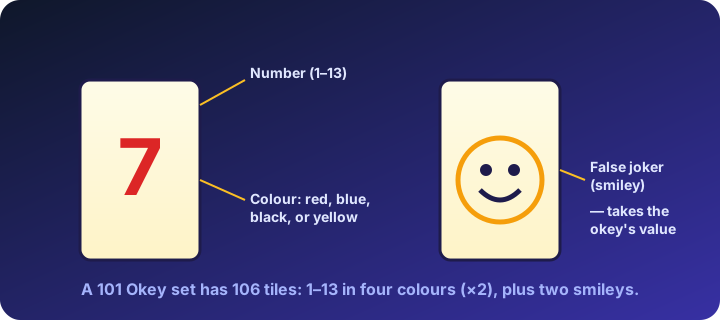
- A 101 Okey set — 106 plastic tiles total. There are tiles numbered 1 through 13 in four colours (red, blue, black, yellow), with two of each tile. There are also two extra "smiley" tiles, the false jokers (Turkish sahte okey).
- Four players. Not three, not five — the hand sizes, draw mechanics, and pair-counting all assume exactly four.
- A flat surface and four racks to hold tiles facing each player.
Setup and dealing
Shuffle all 106 tiles face-down on the table and stack them into four neat piles of 26 (one tile is left over for the indicator — see below). Each player draws 21 tiles for their rack. The starting player — usually the dealer — draws 22. The remaining tiles form the draw pile (sometimes called the bank) in the middle.
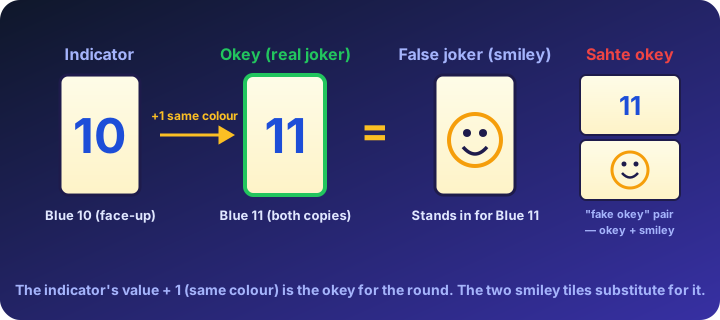
Now flip one tile from the top of the draw pile face-up and place it next to the pile. This tile is the indicator (Turkish gösterge). It will not be played; it just sits there for the rest of the round to define the joker.
How the indicator picks the joker
The joker (Turkish okey) is the tile of the same colour as the indicator with a number one higher. So:
- Indicator Blue 10 → joker is Blue 11 (both copies act as the okey).
- Indicator Yellow 7 → joker is Yellow 8.
- Indicator Red 13 → joker wraps to Red 1.
The two smiley tiles are false jokers. They take the value of the real okey for any meld — at Blue 10 indicator, each smiley counts as a Blue 11 anywhere it sits. They do not count as the actual okey for the doubling rule when discarded last.
Turn structure
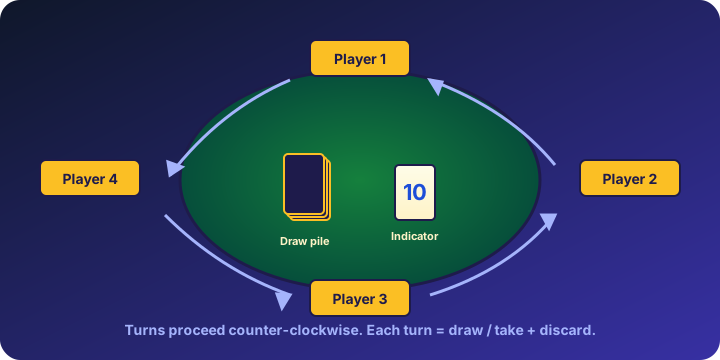
Play moves counter-clockwise (to the right). On your turn you do exactly two things, in order:
- Draw or take. Either draw a face-down tile from the draw pile, or take the tile your right-hand neighbour just discarded — but taking comes with a strict obligation (see "Opening" below).
- Discard. Place one tile from your hand face-up to the right of your rack. That tile becomes the discard available to the next player.
The starting player — who began the round with 22 tiles — skips the draw and goes straight to a discard.
Building runs and sets
To win, you'll arrange your 14 tiles (after your last discard) into valid formations:
- Runs are at least three tiles of the same colour in numerical order: Red 7-8-9, Black 11-12-13, Yellow 1-2-3. Runs do not wrap from 13 back to 1.
- Sets are 3 or 4 tiles of the same number in different colours: Red 8 / Blue 8 / Black 8 is valid; Red 8 / Red 8 / Blue 8 is not (duplicate colour).
The joker can substitute for any tile inside a run or a set.
The 101-point opening rule
This is the rule the game is named for, and the one that separates 101 Okey from regular Okey. You cannot lay any tiles on the table until the formations you're laying down are worth at least 101 points combined.
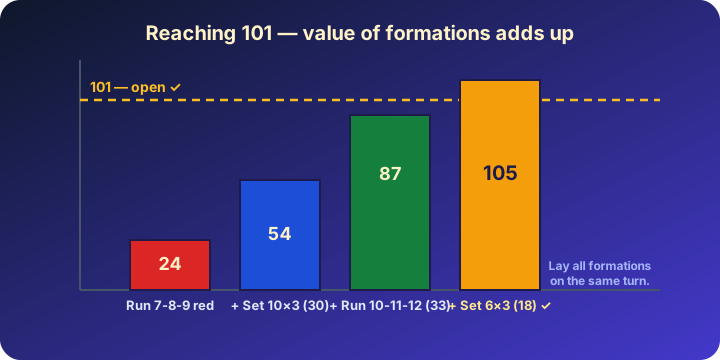
Tile values equal their printed numbers — a 7 is worth 7 points, a 12 worth 12. The joker takes the value of whichever tile it stands in for. So a typical opening might be:
- Run: Red 7-8-9 → 7 + 8 + 9 = 24 points
- Set: 10 / 10 / 10 → 30 points (cumulative 54)
- Run: 10-11-12 same colour → 33 points (cumulative 87)
- Set: 6 / 6 / 6 → 18 points (cumulative 105)
That last set crosses the threshold. You lay down all four formations on the same turn — opening piecemeal across multiple turns is not allowed.
Taking from your right-hand neighbour
If a tile your neighbour just discarded would push you over 101 and you can lay all your formations right then, you may take that tile instead of drawing from the pile. But there's a strict obligation: you must open your hand on the same turn, and the formation containing the taken tile must be among the ones you lay down. Many house rules also penalise the giver — when player B opens with a tile player A discarded, player A pays a small penalty (usually that tile's value × 10).
Finishing the round
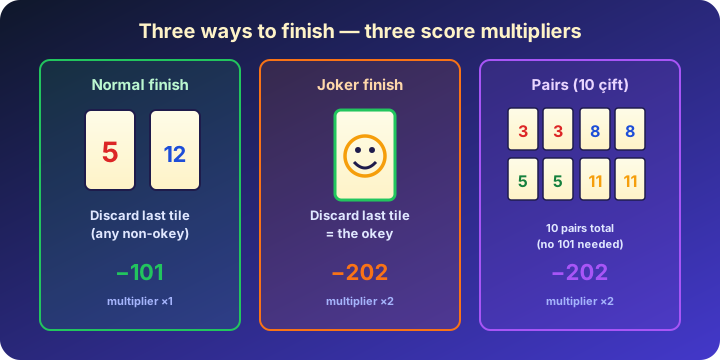
Once you've opened, you can add tiles to any meld already on the table — your own or another opened player's — on subsequent turns. To win the round, discard your last tile from your hand. There are three flavours of finish:
- Normal finish. You discard any non-joker tile as your last move. Winner scores −101.
- Joker finish (çift okey / double okey). You discard the joker as your last tile. Winner scores −202 and every other score in the round doubles.
- Pair finish (10 çift). You collected ten distinct pairs in your hand instead of runs and sets. You announce it on your turn and win immediately, no 101-point opening required. All scores double, just like a joker finish.
Scoring after the round
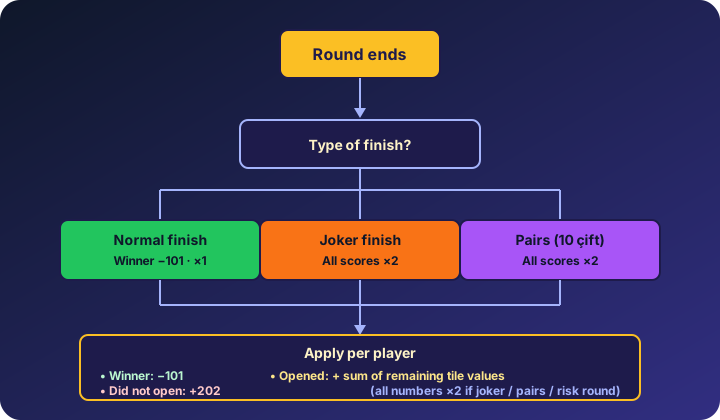
When the round ends, three things happen for every player:
- Winner: −101 points (lower total wins the match overall).
- Players who opened: receive the sum of the numbers on their unfinished tiles as penalty (so 5 + 8 + 11 = +24).
- Players who never opened: receive a flat +202 penalty regardless of what's in their hand — the steepest round-end penalty in the game.
If the round was a joker finish, a pair finish, or a risk round (when the indicator is itself a smiley), every score above is multiplied by 2.
A typical match
Most evenings run 10 or 11 rounds. After the last round, add up cumulative scores per player; lowest total wins. The cumulative math is the part that keeps people scribbling on paper or, more often these days, opening this app to track scores in real time.
Common beginner mistakes
- Opening too late. The flat +202 for never opening hurts more than most beginners realise. If you can plausibly open by round 5 of your hand-building, do so even with a thin margin over 101.
- Overvaluing the joker. The joker is worth ~10–13 flexible points, but if you sit on it waiting for a "joker finish" your other 13 tiles need to already be nearly complete. Otherwise you'll lose the round with a wild in hand.
- Not tracking the indicator. The indicator never moves but it's easy to forget halfway through a round which tile is the joker. Glance at it after each draw.
Variants and house rules
Before the first round, agree on three house-rule questions: whether the discard-penalty rule is on, whether risk rounds are played, and the match length. Almost every mid-match dispute traces back to those three.
Where to go from here
Get comfortable with the basics, then read our opening strategies guide, the scoring deep-dive, and the defensive play handbook. When you're ready to play with family on different devices, start a free match and share the PIN — no installs.