
Five Essential 101 Okey Strategies
Five battle-tested habits that turn losing rounds into winning ones — read discards, manage the joker, defend near 101, and more.
Five Essential 101 Okey Strategies
Most 101 Okey players know the rules but lose anyway. The gap between knowing the rules and winning consistently is a handful of habits — read the right tiles, play the joker at the right moment, defend at the right time. This article walks through the five highest-leverage strategy moves that turn losing rounds into winning ones.
1. Read every discard like a poker tell
Every tile your opponents throw is a piece of information they can't take back. Each discard tells you a tile they have decided not to need. Track this:
- Two consecutive low discards in the same colour usually mean a high run. If a player throws Red 3, then Red 4 a turn later, they probably have Red 7-13 territory if anything.
- A high discard early often means no run in that colour. Red 11 thrown on turn two means they've given up on red runs.
- Sets are harder to read. A discarded 8 doesn't tell you much about whether they have a set of 8s — they might have just chosen a different 8 to keep.
The goal isn't to deduce their entire hand. It's to know which of your tiles are safe to discard and which would give them a key piece. Over a 10-round match, this single skill is worth ~30–60 cumulative points.

2. Hold the live joker until you can see what it's worth
The joker is worth roughly 10–15 effective points beyond its face value, if you place it well. Slotting it into the first available pair (especially a low pair like 3/3) wastes most of that value.
The discipline: wait one full circuit of the table before placing the joker, unless using it now puts you immediately over 101. In that one circuit you'll see two more discards from each opponent, which often reveals whether you can complete a higher-value formation that the joker would slot into much more profitably.
The exception: if holding the joker means delaying your opening past a probable closer (someone is clearly close to winning), play it now. A joker in a sub-optimal slot is still worth more than a joker in your hand when the round ends.
3. Watch the indicator like the indicator is the point
The indicator never moves. Easy to forget. By round three of a hand you've drawn 8–10 tiles and you're focused on your rack, not the table. Glance at the indicator after every draw, and ask:
- What is the joker right now? This sounds obvious but ask it explicitly each turn.
- Has anyone discarded the joker? If not, somebody has it. (You included.)
- If the indicator is itself a smiley — risk round, all scores doubled. Adjust your aggression accordingly.
A small notebook trick: when you're learning, keep one finger pointing at the indicator throughout the round. Eventually it becomes automatic.
4. Play defensively when an opponent is one round from finishing
When an opponent has opened and is laying down extensions on consecutive turns, they're 1–2 turns from finishing the round. Your priority shifts from building to starving:
- Discard tiles that can't extend their visible melds. Off-colour numbers, off-pattern numbers.
- Never discard the joker. Almost certainly someone else's finish ticket.
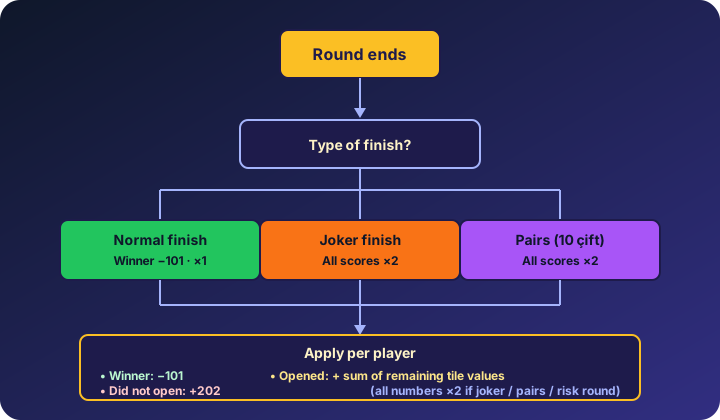
- Hold high-value tiles instead of discarding them. If the round ends with you not opened, the +202 flat penalty hits regardless of what you're still holding. Keeping the high tiles costs nothing and starves the closer of tools.
- Don't take from the predecessor unless you can open right now. Otherwise you've spent your turn picking up a useless tile.
A perfectly defended round is one where you eat the +202 flat penalty but the leading player only takes −101 instead of −202. The +101 you saved on their side still beats the −101 swing you'd otherwise concede on yours.
5. Track cumulative scores ruthlessly
Most family games are decided by 80–200 cumulative points across an evening. Knowing exactly where everyone stands changes your strategic posture every single round:
- If you're leading, play conservatively. Take the +24 small penalty rather than risk a doubled finish loss. You don't need to win rounds; you need to not lose them badly.
- If you're middle of the pack, play your normal game. Open when you can, hold the joker if it makes sense.
- If you're behind, you need a swing round. That means going for a joker finish or a pair finish. Hold the joker more aggressively. Aim for the −202.
This is the part where the math gets exhausting if you're keeping score on paper. The 101 Okey Assistant keeps the cumulative totals updated in real time on every player's device, so the strategic context is always visible without anyone running calculations in their head.
Putting it all together
These five habits compound. A player who tracks discards but doesn't watch cumulative scores will play the same way whether they're leading by 200 or losing by 200. A player who plays defensively but doesn't read discards is defending the wrong tiles. The strongest 101 Okey players combine all five and adjust constantly.
A typical match-deciding sequence:
- Round 1–3: read each opponent's discard pattern and start building a mental map of their hand shape.
- Round 4–6: when you have a strong hand, open as soon as you cross 101. When you have a weak hand, defend.
- Round 7–10: cumulative scores are starting to settle. Adjust aggression based on whether you're leading or trailing. Hold the joker only if you're within striking distance of a doubled finish.
- Final round: this is where the trailing player goes for broke. If you're leading, play the safest possible defensive round.
Beginner pitfalls to avoid
- Trying to play "perfectly" every round. 101 Okey rewards adapting to what you draw, not forcing a textbook plan onto a bad hand.
- Holding the joker for a finish on a hand that isn't close. The math doesn't work out unless you're 1–2 tiles away.
- Forgetting to look at the cumulative scoreboard. Many beginners play every round identically. The score context should change your strategy.
- Taking from the predecessor "just in case". You must open immediately or you've broken the rule.
- Throwing tiles late in the round just to discard. Late-round discards are when opponents are most desperate for completing tiles.